Let’s talk about reading comprehension in middle school.
Not the Pinterest version.
The real version.
The version where:
- half your kids are still learning to actually read fluently
- the other half can read but have no clue what they just read
- and a solid 3–6 students are staring into the middle distance like they’re waiting for the school day to buffer 🌀
And you’re over here trying to teach “analysis” and “theme” and “text evidence” while also wondering if your coffee counts as a meal.
So when people say things like:
✨ “Just do close reading!” ✨
…I want to gently place my head on my desk.
Because the truth is:
Comprehension doesn’t improve from one giant lesson.
It improves from small daily habits that train students to think while they read.
That’s why this post is all about a routine that takes 10 minutes a day (yes, truly) and builds real comprehension over time.
No fancy tech.
No 47 handouts.
No grading mountain.
Just a simple, repeatable structure you can use with ANY text:
- short story
- novel chapter
- article
- poem
- test passage
- even your Monday Method nonfiction articles 👀
Let’s do it.
The Problem With Middle School Reading Comprehension (It’s Not Just “They Don’t Get It”)
Most teachers assume comprehension struggles mean:
❌ “They’re not paying attention.”
❌ “They’re not trying.”
❌ “They don’t care.”
Sometimes… sure.
But more often, it’s this:
Middle schoolers don’t automatically do the thinking work of reading.
They read words. They don’t build meaning.
They don’t:
- pause and process
- connect ideas
- visualize
- predict
- clarify confusion
- track character changes
- notice tone shifts
- ask questions
- summarize meaningfully
And if they don’t practice those moves constantly, they don’t get better at them.
So we need a daily routine that quietly builds those muscles.
The 10-Minute Reading Routine (the whole thing)
This routine has 3 parts and you can do it at the start of class, mid-lesson, or as a reset when the energy is off.
✅ Total time: 10 minutes
✅ Total prep: basically none
✅ Total grading: optional (and tiny)
Here’s the routine:
Step 1 (2 minutes): “Set the Purpose”
Step 2 (5 minutes): “Read + Think”
Step 3 (3 minutes): “Prove You Got It”
That’s it.
Now let’s break it down so you can actually use it tomorrow.
Step 1 (2 minutes): Set the Purpose (aka: “What are we looking for?”)
This is the part teachers skip when we’re rushed… and then we wonder why students read like zombies.
If kids don’t know what they’re reading for, they default to:
📉 “I read the words. I’m done.”
So you’re going to give them one focus.
Not five.
Not a full worksheet.
Just ONE “reading lens.”
Pick ONE purpose question per day:
Here are purpose prompts that work for grades 6–8:
Character lens
- What does the character want in this section?
- What’s changing for the character right now?
Theme lens
- What message is the author hinting at here?
- What lesson is being learned (even subtly)?
Conflict lens
- What problem is getting worse?
- What obstacle is in the way?
Mood/Tone lens
- What’s the mood of this scene? What words create it?
- What’s the author’s attitude here?
Inference lens
- What can we infer that isn’t directly stated?
- What does this detail suggest?
Structure lens (great for nonfiction)
- What is the author doing here: explaining, comparing, proving, warning?
- What’s the main idea of this chunk?
Teacher script (steal this):
“Today we’re reading with ONE job: we’re tracking _____. When you finish reading, you should be able to prove it with a detail from the text.”
Step 2 (5 minutes): Read + Think (with a micro-thinking task)
Now we read.
But we’re not doing “read silently and hope for the best.”
We’re doing read with a tiny thinking move that forces comprehension.
You have 3 options here depending on your class:
Option A: “Stop & Jot” (best for accountability)
Students read a short chunk (or you read together) and then do ONE quick jot:
Stop & Jot Prompts
- What just happened? (summary in 10 words)
- What changed?
- What’s the character thinking?
- What’s the author’s point here?
- What’s one line that feels important and why?
Important rule:
One sentence. One minute. Move on.
Option B: “Margin Marks” (best for low stamina classes)
Students mark the text using simple symbols:
- ⭐ = important
- ❓ = confusing
- 😮 = surprising
- 💡 = inference/realization
Then they write ONE note next to ONE mark.
This works really well for:
- struggling readers
- students who hate writing
- classes where you need a low-friction win
Option C: “Teacher Think-Aloud” (best for training their brains)
This is where you model the thinking they don’t do naturally.
You read a few lines and say things like:
“Okay, I’m noticing the author keeps repeating this idea… that tells me it’s important.”
“This detail makes me think the character is lying… because…”
“I’m confused here, so I’m going to reread that sentence.”
Think-alouds are like showing kids how your brain reads.
They need that because right now their brain reads like:
words words words words… done.
Step 3 (3 minutes): Prove You Got It (quick comprehension check)
This is the part that makes the routine actually work.
…Because if there’s no proof, students learn:
“I can fake reading and nothing happens.”
So you need a tiny output—Not a full assignment, just proof.
Pick ONE of these “proof checks”:
Proof Check #1: The 3-2-1 (classic for a reason)
- 3 things that happened / 3 key details
- 2 interesting words or phrases
- 1 inference or takeaway
OR for nonfiction:
- 3 key facts
- 2 cause/effect relationships
- 1 main idea statement
Proof Check #2: “Somebody Wanted But So Then Because”
Perfect for fiction and short stories.
- Somebody…
- Wanted…
- But…
- So…
- Then…
- Because (why it matters)
It’s a summary structure that builds comprehension.
Proof Check #3: One Sentence Summary (with training wheels)
Give them a frame:
In this section, ____ because ____.
Or
The author’s main point is ____ and they support it by ____.
Proof Check #4: Evidence Snapshot (the bridge to writing)
This is where you start building evidence habits without writing an essay.
Students answer the purpose question AND include one detail:
I think _____ because the text says/ shows _____.
This is SUCH a good lead-in to evidence-based writing (and it’s way less intimidating for kids).
➡️ Related: [Stop the Copy/Paste Quotes: How to Teach Text Evidence in a Constructed Response]
What This Routine Looks Like in a Real Week (so it’s not random)
Here’s a weekly plan that builds different comprehension muscles without you reinventing the wheel daily.
Monday: Main Idea / Summary
Purpose: “What is this mostly about?”
Proof: one sentence summary
Tuesday: Inference
Purpose: “What can we figure out that isn’t said?”
Proof: I infer ___ because ___
Wednesday: Vocabulary in Context
Purpose: “Which words matter most and why?”
Proof: define 2 words using context clues
Thursday: Structure / Author’s Craft
Purpose: “What is the author doing here?”
Proof: explain one craft move
Friday: Theme / Big Takeaway
Purpose: “What message is building?”
Proof: theme statement + evidence
This works for:
- novels
- nonfiction articles
- test passages
- short stories
- paired texts
- literally anything
And it builds the exact thinking skills students need for state tests without turning your classroom into a test prep dungeon.
“But Laura, My Kids Won’t Do It…” (Let’s fix that)
Okay, fair. Middle schoolers can be… selectively motivated. 😄
Here are the 5 fixes that make this routine actually stick.
Fix #1: Make the proof check tiny
If it feels like work, they resist.
If it feels like a quick win, they (typically) comply.
Aim for:
✅ 1–3 sentences max
✅ 1 sticky note
✅ 1 quick response box
✅ 1 small half-sheet
Fix #2: Don’t grade it all (spot check instead)
You do NOT need to grade every response.
Try:
- stamp it
- checkmark it
- collect 5 random notebooks
- walk around and glance
- have them hold it up
Accountability ≠ grading.
Fix #3: Give choices
Let them pick their proof check:
“Choose ONE:
A) 3-2-1
B) Somebody Wanted But So Then
C) One sentence summary”
Kids love choice. Teachers love not fighting.
Fix #4: Use a timer (seriously)
A visible timer turns “I’ll do it later” into “fine I’ll do it now.”
Fix #5: Repeat the routine until it becomes automatic
This is the big one: Comprehension routines only work if they become habit. You’re training their brains, and brains need repetition.
How This Routine Supports Struggling Readers (without embarrassing them)
This routine is sneaky differentiation.
Because:
- purpose question gives focus
- stop & jot breaks reading into chunks
- proof check gives structure
- short time limit keeps it manageable
For your struggling readers, the routine reduces overwhelm.
For your higher readers, you can deepen the “purpose” question.
Same routine. Different level of thinking.
Want to Make This Even Easier? Turn It Into Stations 😄
You know I’m going to say it.
This routine works BEAUTIFULLY in stations.
Station Setup (10–12 minutes each)
- Station 1: Read + Stop & Jot
- Station 2: Vocabulary in context
- Station 3: Inference + evidence snapshot
- Station 4: Summary / theme response
This is exactly why stations are so powerful for reading comprehension:
Kids get repetition without boredom.
➡️ Related: [Stations That Keep Kids Engaged]
Your “Tomorrow Plan” (so you don’t overthink it)
Here’s what to do tomorrow:
- Pick a text (anything you’re already teaching)
- Choose ONE purpose question
- Set a timer for 5 minutes of reading
- Do ONE proof check
- Spot check, don’t grade
That’s it. If you do this 3–4 times a week, you’ll start seeing students:
- summarize more clearly
- infer more accurately
- discuss with more confidence
- write about reading with less whining
- and stop pretending they read when they didn’t 😅
Final pep talk
Comprehension doesn’t come from “covering” more standards.
It comes from building better reading habits that work in real classrooms with:
- interruptions
- behavior issues
- missing work
- random assemblies
- and kids who forget their supplies daily
This 10-minute routine is the kind of thing you can actually sustain.
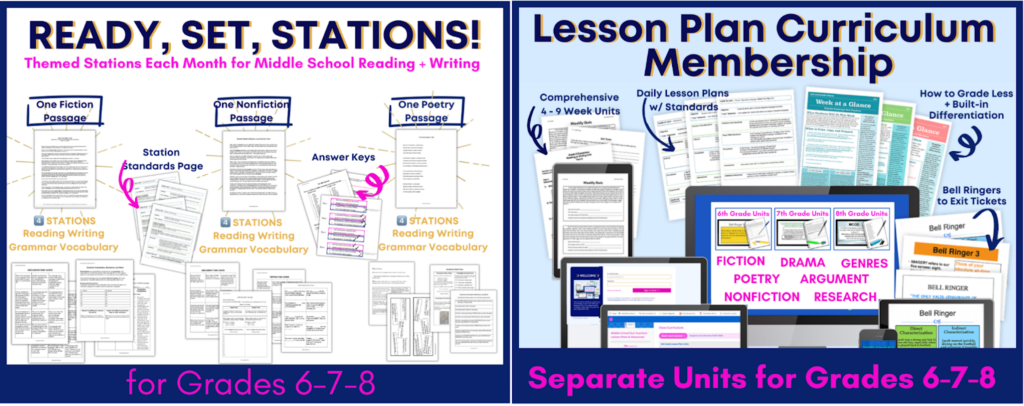
Reading, writing, grammar, vocabulary, speaking, and listening are all embedded inside both the ready-made ELA Lesson Plan Units AND the Ready, Set, Stations™ materials for consistent, non-random learning experiences that spiral alongside everything else you’re teaching. Take your pick!