What I wish I’d figured out a long time ago was how to stop reinventing the wheel for every novel and instead, follow a structure for myself that I could basically rinse+repeat regardless of the type of novel I was doing. And really, when it comes down to it, whatever novel you’re doing (even grade level doesn’t matter), you can basically follow pretty much the same process every time. For me, when I think about it, it helped me plan things out in advance once I realized I had a process I could follow every time. So in case it’s helpful for you, here’s what it is (do this for every novel):
Part 1: Build Context / Interest / Anticipation
- Hook activity (short video, historical background, anticipation guide, quick debate, 20 questions).
“20 Questions” is my all-time favorite way to introduce a novel. I do this before doing anything else novel-related. In fact, the less students know about the novel, the better. As a class, they get 20 questions TOTAL that they can ask me regarding the book we’re going to start reading, but the trick is that I can ONLY answer yes or no to their questions. So questions like, “Does someone die” are easy to answer, but questions like, “Does it take place in the 1980s” are wasteful because now you just wasted a precious, limited question on a single decade. The critical thinking very quickly kicks in and kids start huddling up to strategically plan their questions so they don’t waste them. It’s a lot of fun, and kids usually BEG to start reading by the time the game is over.
- Pre-reading vocabulary (just the essentials to start with maybe based on historical context or geography—don’t overdo it).
- Student prediction/journaling prompt: “Based on what you know from playing 20 Questions, what would you expect to see in the novel? What are you excited about? What seems interesting or confusing?”
Part 2: The Daily, Active Reading Routine
- Consistent check-ins as you read (Every chapter? Or every 2–3 chapters? Or at natural breaks).
- At each stopping point:
- Quick-write (theme, character shift or POV, quote, plot development, conflict, etc.)
- Discussion question followed by partner chat followed by continued writing (like adding in text evidence, quotes, commentary to the original writing response depending on how formal you want it to be)
- Maybe a station activity (reading, writing, vocab, grammar practice that relates back to the book in some way)
- Students do their thinking / doodling / written responses in the same place every time (like in their composition notebooks, or reader response journals, or wherever you have them normally do this for other things)
Part 3: Deep Dive Mini-Lessons
*** (This is what you do while also moving through Part 2 because some days will be more Part 2-focused while others will be more Part 3-focused depending on where you are in the novel)
- After finishing big or important sections, zoom in:
- Mini-lessons on the author’s craft (tone, mood, symbolism, irony, word choice, etc.).
- Short writing responses where students get to practice implementing the lesson into their own work, like imitating tone or POV in their own writing
- This is where keeping track of intense paragraphs or especially meaningful sentences throughout the book can be really helpful since they’ll serve as your “mentor text” mini-lesson deep dives. Ex: “Oh wow, this whole thing is one sentence? Hmm… the author breaks it up with hyphens, semi-colons, and comma/conjunctions. Let’s break this down and model it. We’ll pick our own topic and copy the format of the sentence and see how close we can get. What should our own topic be? Oranges? Great. So we’ll start by imitating this sentence but we’ll be writing about oranges instead. Let’s see if we can do it.”
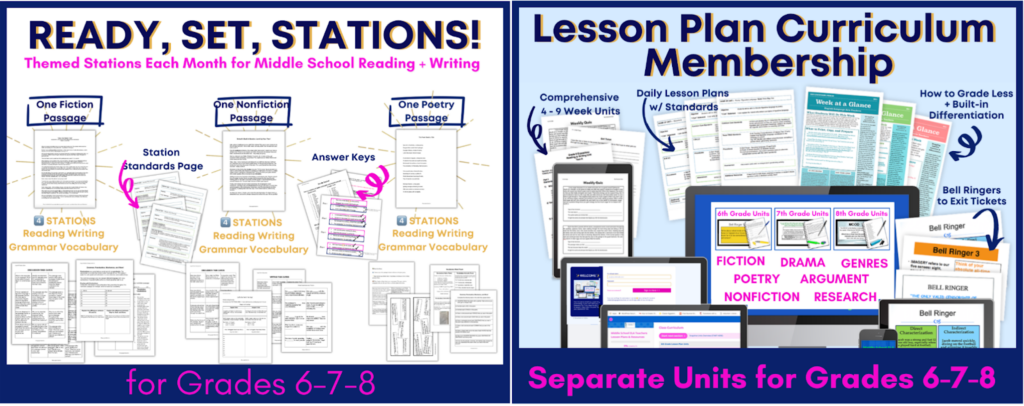
Students read and write every day in both the ready-made ELA Lesson Plan Units and in the Ready, Set, Stations™ materials. While those resources don’t contain specific novel units, they are set up for big-time flexibility so you can plug your class novel(s) into the learning anywhere you want. If you love having a structure to your days and a routine that you and your students can count on, then take your pick of either the ELA Lesson Plan Units or the Ready, Set, Stations™ materials.