If you’ve ever read a student speech or essay and thought…
- “These ideas are fine… but why does this feel so awkward?”
- “Why does this sound like five paragraphs stacked on top of each other?”
- “Why did they jump from THIS idea to THAT one with zero warning?”
…then like so many of us, you’re working through the paragraph flow problem zone.
Students struggle with how ideas connect, which isn’t solved by just “teaching transitions.”
It’s:
Teach HOW transitions reveal the logic of the writing.
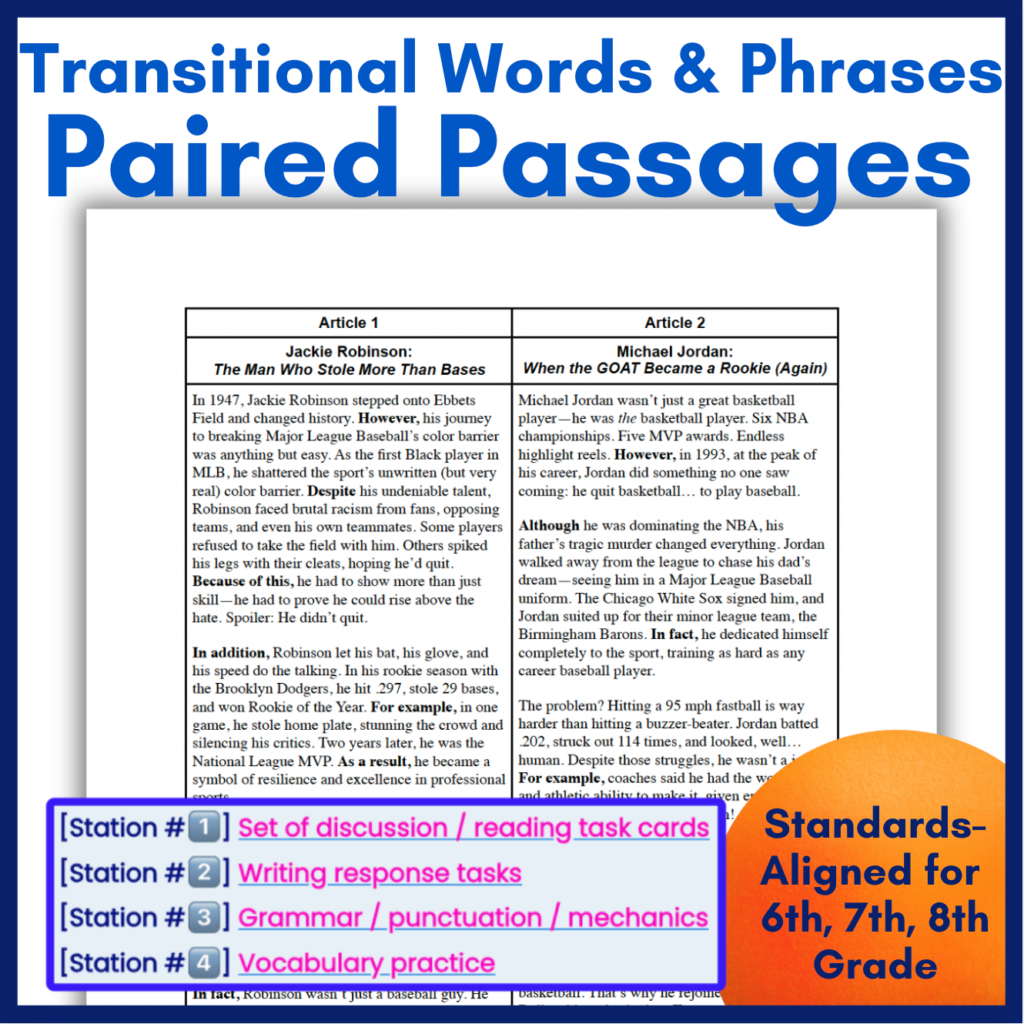
Let me show you my no-prep, highly engaging mini-lesson that does exactly that, using a short paired nonfiction passage I wrote about Jackie Robinson and Michael Jordan + one deceptively simple grammar station.
This is the kind of lesson students actually talk about, staying on-task.
Why Paragraph Flow Is So Hard for Middle Schoolers (And Why That’s Normal)
From a student’s perspective, writing paragraphs feels like this:
Paragraph = one idea
New paragraph = new idea
End of story
So they stack paragraphs like LEGO bricks without any connectors.
What they don’t see yet is that:
- paragraphs exist in a sequence
- the sequence should be intentional
- and transitions are the signals that guide the reader through that intentional sequence
That’s not obvious to a 13-year-old, which is why this strategy works so well since it makes the invisible visible.
Step 1: Start With a REAL Text That Already Flows
Instead of starting with a list of transition words (which students immediately ignore), start with a text that already does the work for them.
The paired nonfiction passage comparing Jackie Robinson and Michael Jordan is perfect for this because:
- it’s short
- it’s high-interest (sports + GOAT energy)
- it uses transitions constantly
- and it clearly moves from one idea to the next
March NF Reading Passage with T…
Have students read the passage without any grammar task first.
Just read.
Then ask:
- “Did this feel smooth or choppy?”
- “Did you ever feel lost?”
- “Did the paragraphs feel random… or connected?”
Most students will simply say, “IDK, it just made sense.”
Perfect. That’s your opening.
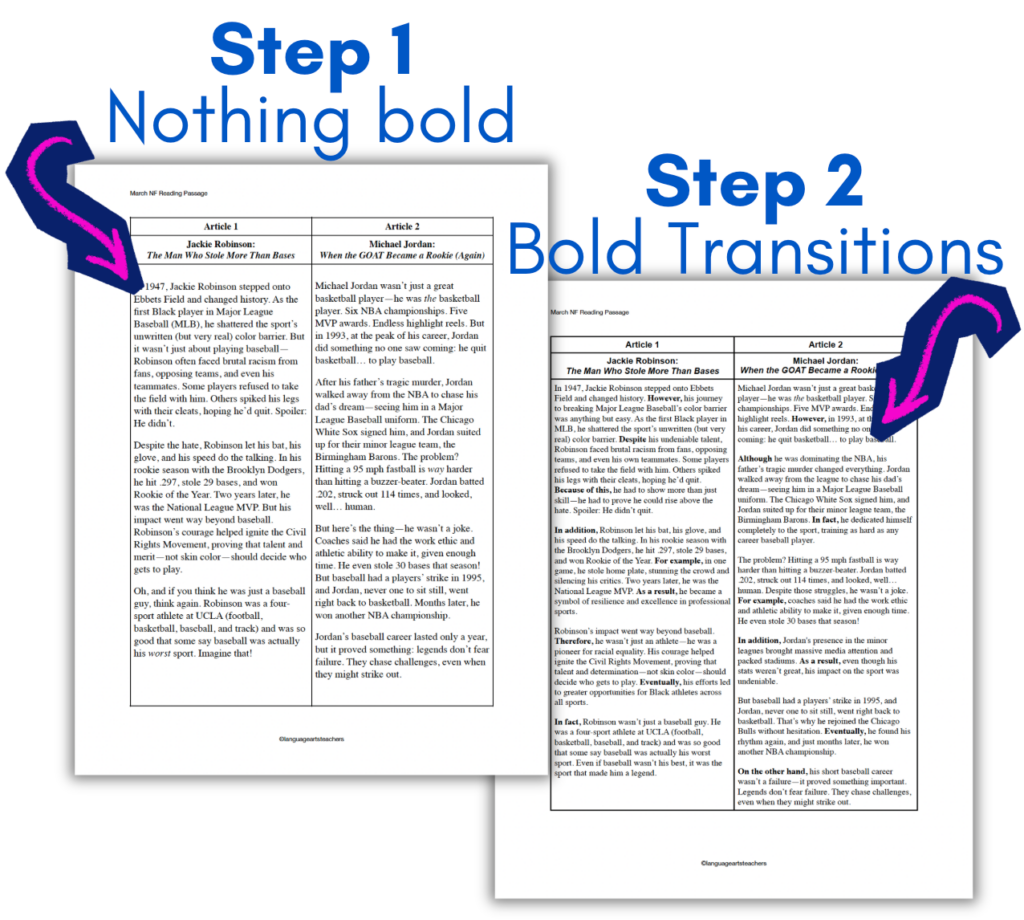
Step 2: Make Transitions Impossible to Miss
Give students the same passage again, but this time with the transition words and phrases bolded — essentially an answer-key version of the text
You don’t explain anything yet.
You just ask:
- “What do you notice?”
- “What kinds of words keep popping up?”
- “Where do you see them — beginning of paragraphs? Middle? End?”
Students will start noticing patterns like:
- However when the idea shifts
- For example when evidence is introduced
- As a result for cause and effect
- Eventually for time shifts
- On the other hand for contrast
This is such an important moment because students discover the function of transitions before learning the labels.
That’s how it sticks.
Alternative to Consider IN LIEU OF Steps 1-2 Above:
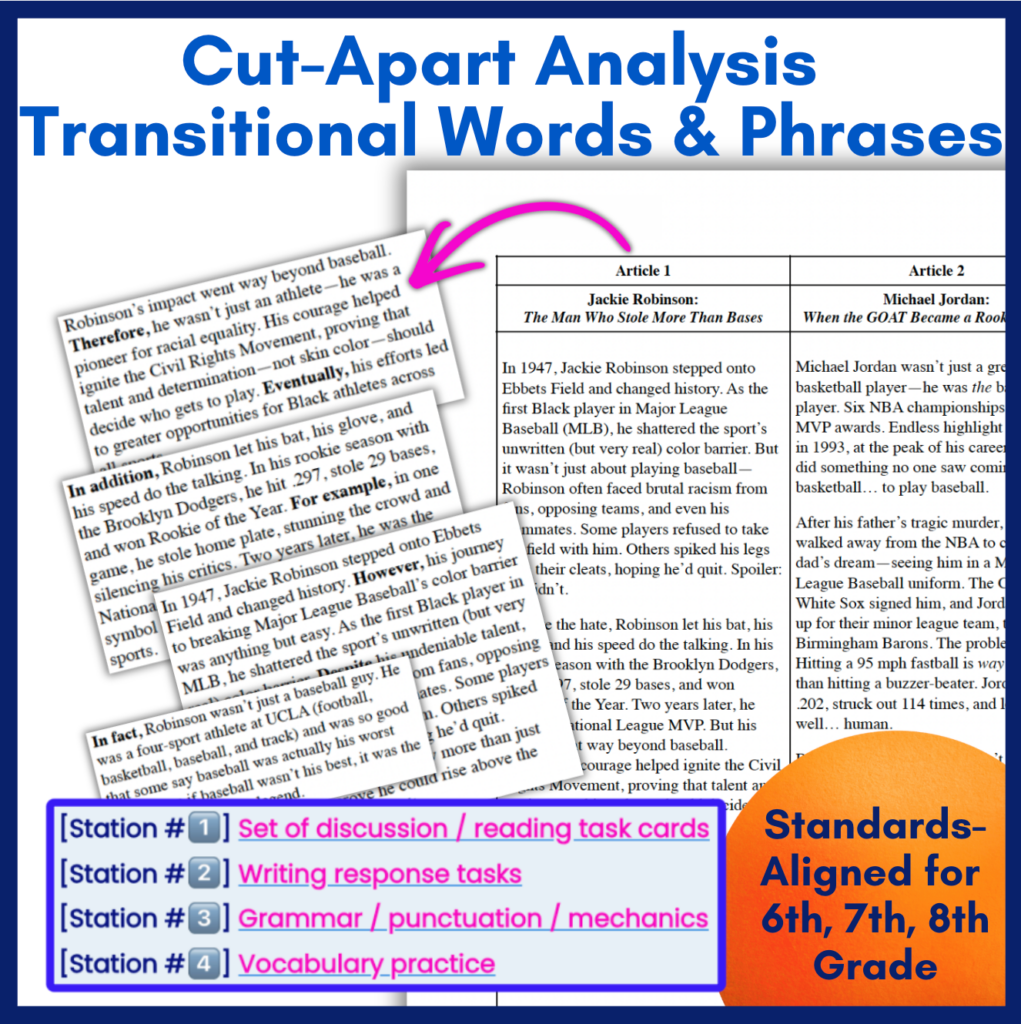
Physically Cut the Paragraphs Apart (Yes, Really)
This is where the lesson goes from “good” to memorable.
Print the article and cut each paragraph into a separate strip.
Then give groups a simple challenge:
“Put these paragraphs back in the order that makes the most sense.”
No transition list.
No notes.
Just logic.
Students will:
- argue (productively)
- justify choices
- notice which paragraphs need to come before others
- realize that transitions are clues, not decorations
And when groups disagree?
That’s your discussion gold.
Because now you can ask:
- “Which transition helped you decide?”
- “What paragraph had to come before this one?”
- “What would be confusing if we switched these?”
This one activity teaches:
- organization
- paragraph sequencing
- and the purpose of transitions
…without a single worksheet.
NEXT: Connect It Directly to Student Writing (The Non-Negotiable Part)
Now you pivot.
Say something like:
“Okay… now let’s look at YOUR writing.”
Have students pull out:
- An old speech they wrote
- An essay from last week or last month
- Or even a rough outline from a current writing assignment
It doesn’t matter how new or how old the writing piece is, or whether it was a “formal” graded assignment or just a casual warm-up / creative journaling task. The point is that it’s something THEY already wrote and not a random worksheet.
And ask them to do just two things:
1️⃣ Identify the purpose of each paragraph
Is it:
- Introducing a topic?
- Explaining something?
- Giving evidence or proof?
- Showing a contrasting point?
- Concluding the whole thing?
2️⃣ Add ONE transition per paragraph
Not ten.
Not a whole paragraph rewrite or a whole essay rewrite.
Just:
- one transition inside the paragraph
- one transition connecting it to the next paragraph
This keeps the task doable, specific, and powerful.
Why This Works So Well (Without Extra Prep)
This strategy works because it:
- starts with meaning, not rules
- uses a real mentor text
- makes structure visible
- invites discussion
- and immediately transfers to student writing
It’s also extremely flexible:
- whole-class
- small group
- stations
- one day
- or spread across two or more short lessons
And best of all, it doesn’t feel like “grammar time.” Instead, it feels like learning how writing actually works.
Want This Kind of Lesson Ready-Made Every Month?
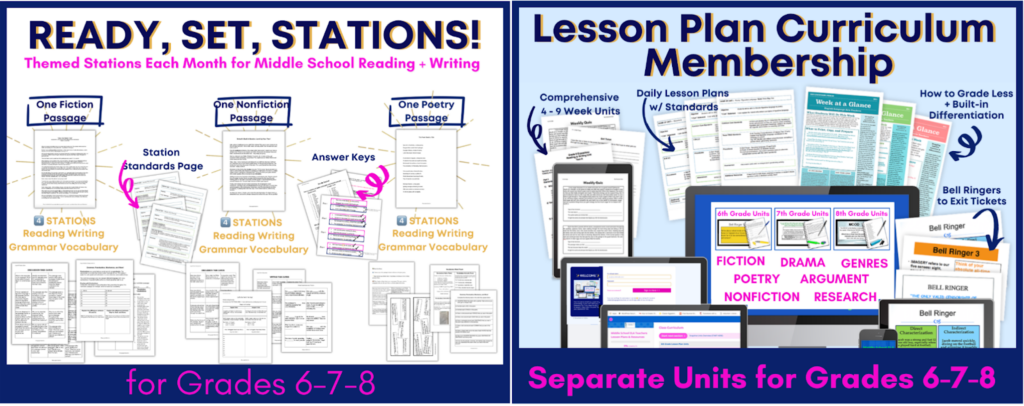
This exact type of lesson — reading + grammar + writing + discussion — is what I build inside Ready, Set, Stations™.
Each month includes:
- high-interest texts
- built-in grammar moves
- discussion-worthy questions
- and writing connections that don’t require extra planning
So instead of scrambling to invent lessons like this on the fly…
👉 Grab your copy here: Ready, Set, Stations™ and make each month one that you spend more time savoring and less time scrounging for lesson plans.