How many times have you sat down to plan a review day (or a review week) and thought, “Okay… I need to make something new.”
- A new worksheet
- A new slide deck
- A new Kahoot
- A new packet
- A new set of task cards
And before you know it, it’s 9:47 p.m. and you’re knee-deep in the online rabbit hole wondering how your life led to this moment. ☕🫠
Here’s the truth I wish someone had handed me on a sticky note earlier in my teaching career:
You do not need new materials to run a strong review.
You need new ways to use what you already have.
That’s the heart of what I’m sharing here:
👉 spiraling skills instead of creating new activities
👉 using the same texts in multiple ways
👉 turning one resource into 3–5 different learning experiences
If you can get comfortable with those three shifts, your planning life gets lighter, your review days get better, and your students actually remember what they learned.
Let’s talk about how to make that happen in real classrooms with real middle schoolers.
Why “New” Feels Safer (But Usually Isn’t Better)
When teachers plan reviews, the instinct is usually:
“We already did this. They’ll be bored.”
I know that because I’ve been there!
But here’s what we forget:
Students don’t necessarily get bored with the actual text or the material. They get bored with the same task repeated the same way.
If you:
- change the purpose
- change the output
- change the grouping
- or change the thinking move
…you can use the exact same text and it will feel fresh, challenging, and engaging.
That’s what spiraling is really about:
same skills, new angle.
Three High-Impact Ways to Repurpose What You Already Have
Below are three review structures you can plug into almost any unit without needing to create new materials.
You can use these with:
- speeches
- articles
- paired passages
- short stories
- or any nonfiction texts you’ve already taught
Option 1: Discussion Card Speed Review (My Top Pick)
If you already have discussion questions, prompts, or task cards from earlier in a unit, congratulations! You basically have a built-in review game.
Here’s how to run it (zero prep, high impact):
Setup
- Put students in groups of 3–4
- Give each group a set of discussion cards related to key unit concepts
(These could be questions about theme, author’s purpose, rhetorical techniques, evidence, claims, or structure — whatever your unit emphasized.)
The game
- Set a timer for 2–3 minutes per card
- Groups discuss each card, but here’s the twist:
- Instead of tying their answers to one specific text, students must use examples from ANY text they studied in the unit.
- When the timer goes off, groups rotate to the next card.
How students earn points
A group earns a point if they can:
- make a clear claim
- support it with specific evidence from a text
- and explain why that evidence matters
So instead of “Yeah, ethos is important,” they have to say something like:
“In the speech we read earlier, the speaker built credibility by sharing a personal story about failure, which made the audience trust them more.”
Now they’re reviewing:
- persuasive strategies
- author’s craft
- evidence-based thinking
- discussion skills
— all without a single new worksheet.
Why this works so well:
- It’s interactive
- It forces retrieval (which boosts memory)
- It connects across the whole unit, not just one text
- And it’s basically plug-and-play if you already have discussion questions
If you like stations, this also works beautifully as a rotating station activity: same cards, different group, different conversation each round.
Option 2: Vocabulary Blitz Game (Fast, Fun, and Focused)
Instead of making a brand-new vocab review, use a vocabulary list you already have.
Here are two easy game formats that work with almost any set of terms:
Hot Seat (whole class or teams)
- Project a term on the board
- One student sits with their back to the screen
- Their team gives clues without saying the word itself
- The “hot seat” student guesses the term
This is great for reinforcing:
- definitions
- examples
- and real-world application
If students can explain a term out loud, they understand it far better than if they just filled it in on a worksheet.
Around the World (pairs or small groups)
- Students stand in pairs
- You project or call out a term
- The first student to give a correct example of the term moves on
For example, if the term is “emotional appeal,” a student might say:
“A speaker describing how hungry animal images are designed to persuade people to donate.”
This makes vocabulary review fast-paced, competitive, and conceptually meaningful.
Bonus: students keep their own score so you don’t have to track anything.
Option 3: Test Passage Preview Challenge (Sneaky but Brilliant)
Here’s a strategy that feels like a game but is actually extremely effective test prep.
Instead of waiting until test day to look at new passages, have students annotate and analyze them together in advance — not to answer questions, but to think like readers.
How to run it:
- Put students in partners
- Give them a “test-style” passage (excerpt from a novel, or an article, or a poem…whatever works)
- Give them 15–20 minutes to annotate and discuss
Ask them to look for things like:
- the author’s claim
- key evidence
- counterarguments
- emotional appeals
- logical appeals
- important word choices
- shifts in tone or perspective
Their job is simply to understand the text deeply, not to fill in bubbles or write responses.
Then, when test day arrives, use the same passage.
That passage will feel familiar and accessible for struggling readers. The thinking is already done, and now they’re just answering questions.
This is such a powerful way to reduce test anxiety while strengthening close reading skills.
*** Ok, but what about the REAL test… The STATE test (for those of you in that situation)
→ It’s ok. You don’t have to use this strategy for literally every single test you do all year long. But you can use strategically when you’re just getting started in the year, or when you need to build up confidence first, or when you’re testing over a relatively brand-new genre or new concept. Use your discretion.
The Bigger Idea: Same Text, New Thinking Move
If you zoom out from these three strategies, you’ll notice a pattern.
You’re not:
- inventing new materials
- downloading random worksheets
- or scrambling for last-minute activities
You’re simply:
- reusing texts
- shifting the purpose
- and changing the way students interact with them
For example, the same article could be used for:
- a comprehension check
- a vocabulary (words-in-context) activity
- a discussion-based review
- a writing response like TDA / R.A.C.E.S.
- an annotation challenge
That’s five different uses for one piece of content.
How This Saves You Time (and Improves Learning)
When you stop creating new review materials for every unit, a few things happen:
- You plan faster.
You’re repurposing, not reinventing. - Students see connections more clearly.
They realize skills carry across texts (and genres!) instead of starting over every time. - Review becomes deeper, not just repetitive.
They’re not doing the same worksheet again. They’re thinking in new, different ways about the same skill, though. - Your classroom feels more intentional.
Review is purposeful, not frantic.
Your “Try This Tomorrow” Plan
If you want to test this approach right away, pick one of these:
- Discussion Card Speed Review using questions you already have
- Vocabulary Blitz with a list you’ve already taught
- Annotation Challenge with a test-style passage
Instead of needing anything new, just think about a new way to use what you already have at your fingertips.
Final Thought
Reviewing doesn’t have to mean “more work for you.”
When you build your unit around repeatable structures like stations, discussion cards, and targeted annotations, you create a classroom where learning spirals naturally instead of starting over every week.
Ready-made resources for this kind of spiraling are exactly what I’ve crafted + organized inside the Middle School ELA Teachers Lesson Plan Membership.
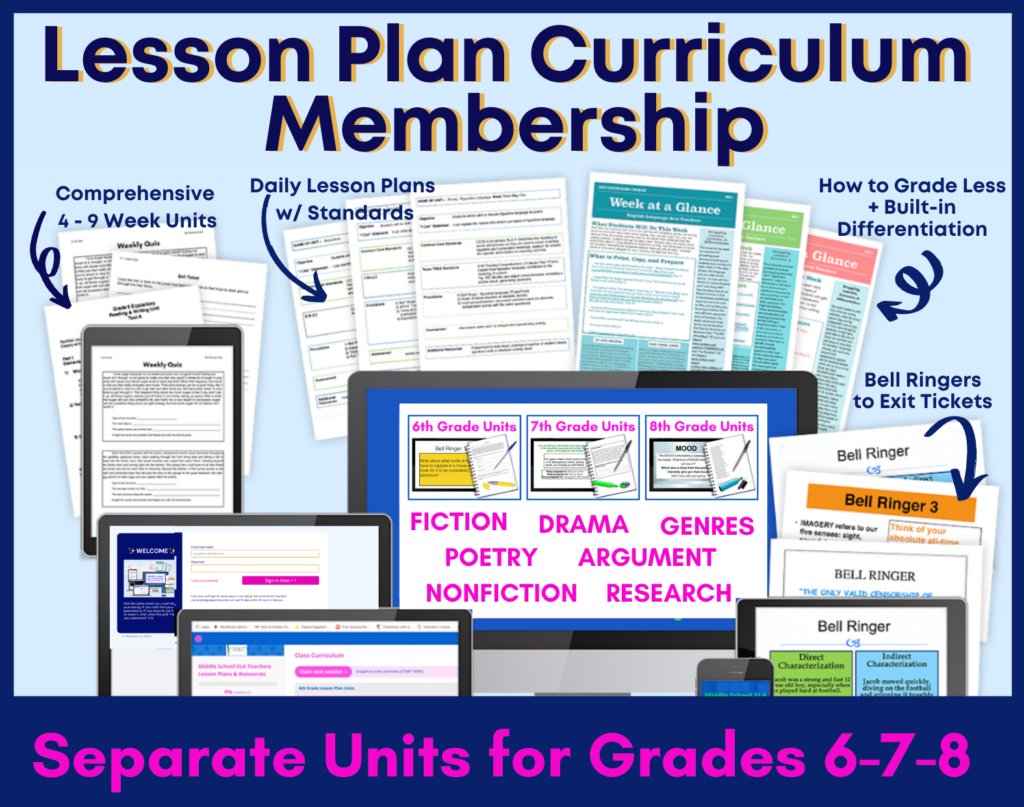
The units (each one is specific to 6th, 7th, and 8th grade instead of just one unit that you can use for all grade levels) let you teach deeply – even if you’re not really an “ELA” person – without burning out.
But whether you’re a member or not, the biggest takeaway is this:
- Stop asking, “What new thing should I make?”
- Start asking, “How else could I use what I already have?”
That one mindset shift will save you more time and help get you home earlier each day without bringing the work with you.