Let’s be honest: middle school engagement is not a cute little bonus.
It’s survival.
Because if students aren’t engaged in ELA, they’re not quietly “not engaged.”
They’re actively… creative about it.
They’re:
- “borrowing” markers they never return
- wandering the room like it’s a museum
- asking 900 questions they could answer by reading the directions
- fake-reading while staring directly at the same paragraph for 12 minutes
- dramatically sighing like you just assigned them a 47-page essay
So when teachers tell me they want stations, what they really mean is:
“I want my students working without me performing like a one-woman show.”
YES.
Stations can absolutely do that.
But only if you build them in a way that works in a real middle school classroom — not a fantasy classroom where everyone has pencils and emotional regulation.
It’s actually way easier for me to show you exactly how to run stations + choice boards in ELA when you come to my next free training on how to setup & run stations the easy, realistic way in the Middle School ELA classroom. In that training—since it’s so visual—I’m using very specific examples, scenarios, images, and scheduling/time options so you can literally start implementing stations tomorrow (or revamp how you’ve been doing them—no prep at all).
But for now, I can also share my tips about stations so they feel:
✅ structured (not chaotic)
✅ engaging (not fluff)
✅ low-prep (not your whole weekend)
✅ accountable (without grading everything)
Why Stations Work So Well in Middle School ELA
Stations are basically the perfect middle school teaching format because they match how kids learn best:
- short bursts of focus (like ~10 minutes for a station is realistic when students are only doing one prompt or one question instead of a whole worksheet that they’re just trying to “get through.”)
- movement (without needing to “sit still and suffer”)
- Variety (each station is different, yet thematically linked so nothing feels random)
- Choice (again, if you’re only spending 10-15 minutes per station, then students can’t possibly do everything… So let them choose!)
- small group interaction (speaking & listening skills)
- clear, repeatable routines (especially when you’re consistent)
And for YOU, stations mean:
- you’re not talking for 47 minutes straight
- students aren’t zoning out
- you can pull a small group
- you can conference
- you can breathe 😄
But here’s the catch:
Stations don’t work when they’re just “cute activities.”
Stations work when they’re skill-building routines.
Stations should feel like:
“This is how we DO ELA here.”
Not:
“This is something random we’re doing today.”
The 4 Station Types That Actually Work in Middle School ELA
If you want stations that don’t flop, start with these.
Station Type #1: The Reading Station (comprehension + thinking)
This station is where students read something and do one focused task.
The key is:
short text + one job
What to use:
- a short story excerpt or paragraph
- a nonfiction article (1 page is perfect)
- a poem
- a passage related to your novel
- paired text excerpts (and maybe it’s from something they’ve read before, so it’s not a “cold” read)
What they do (examples):
- 3-sentence summary
- identify the main idea + 2 supporting details
- inference + evidence sentence
- mood/tone word bank + proof
- theme statement + evidence
💡 Pro tip: The reading station is NOT where you give them a full worksheet or a full story or article they’ve never seen before. That’s how you get “I didn’t do it” energy.
➡️ Related: Come to my next free training on how to setup & run stations the easy, realistic way in the Middle School ELA classroom. I’m using very specific examples, scenarios, images, and scheduling/time options so you can literally start implementing stations tomorrow (or revamp how you’ve been doing them—no prep at all).
Station Type #2: The Writing Station (short response + structure)
This station is where students write something small but meaningful.
What it should feel like:
A quick, repeatable writing routine.
Not an essay.
Not a full draft.
Just writing practice that builds stamina.
Writing station ideas:
- claim + evidence + explanation
- revise a weak paragraph (but be specific–don’t just say “revise this.” Say, “Revise this by adding 3 adjectives, 2 details, and 1 colorful verb.”)
- combine sentences (sentence-level writing = magic)
- respond to a prompt using a scaffold
- write a theme statement + explanation
- write a character trait paragraph
If you want your students to stop saying “I don’t know what to write,” this station is your best friend.
➡️ Related: Come to my next free training on how to setup & run stations the easy, realistic way in the Middle School ELA classroom. I’m using very specific examples, scenarios, images, and scheduling/time options so you can literally start implementing stations tomorrow (or revamp how you’ve been doing them—no prep at all).
Station Type #3: The Language Station (grammar/vocab without suffering)
This station is where you sneak in language instruction in a way that doesn’t make everyone miserable.
Because grammar can be engaging…
…but only if it’s short and interactive.
Grammar/vocab station ideas:
- fix the sentence (with 3 specific edits)
- mentor sentence imitation
- “sentence surgery” (combine + improve)
- roots/affixes mini challenge
- context clues quick practice
- vocabulary in context + part of speech
This station works best when students have:
- an answer key for self-check (they LOVE it when one of them gets to “be the teacher” and check work).
- a “try again” chance
- and a clear goal
Station Type #4: The Collaboration Station (discussion + thinking)
This is where students talk… with structure.
Not chaos.
Not “everyone chatting about nothing.”
Structured collaboration = high engagement + low drama.
Collaboration station ideas:
- 4-question discussion cards
- debate prompt with sentence stems
- ranking activity (most important detail, best evidence, etc.)
- “agree/disagree” with proof
- character decision analysis
- theme vs. lesson sorting
The key is to give them:
- a clear task
- roles (optional but helpful)
- and an output (something to write down)
➡️ I show you what mine are in my Stations trainings, and you’re invited! Come to my next free training on how to setup & run stations the easy, realistic way in the Middle School ELA classroom. I’ll show you very specific examples, scenarios, images, and scheduling/time options so you can literally start implementing stations tomorrow (or revamp how you’ve been doing them—no prep at all).
The “Stations That Don’t Destroy Your Weekend” Planning Method
Here’s the truth: Stations feel exhausting when teachers think they have to reinvent the wheel every time.
But you don’t have to do that. Really, you just need a template.
The 20-Minute Stations Planning Formula
Pick ONE skill focus for the week.
Examples:
- citing evidence
- theme
- inference
- summarizing
- author’s craft
- paragraph structure
- revision
Then build 4 stations around that same skill (so it’s not just ‘random’ stations that are totally unrelated):
- Read (skill practice with text)
- Write (short response)
- Language (grammar/vocab connection)
- Collaborate (discussion or sorting)
That’s it. You’re not creating four unrelated activities; instead, you’re reinforcing one skill four different ways.
Choice Boards: The Lazy Genius Version (aka: “engagement without extra prep”)
Choice boards are perfect for:
- early finishers
- sub days
- review weeks
- test prep weeks
- “I need something structured but flexible” days
The trick:
Choice boards only work when:
- the choices are equally valuable
- the directions are crystal clear
- and the output is consistent
If one choice is “write a paragraph” and another is “draw a picture,” guess what they’re picking.
So instead, make the outputs similar:
Better choice board tasks (all equal-ish effort)
- write 6 strong sentences
- create a 3-part summary
- answer 3 text-dependent questions
- find 2 examples of author’s craft
- write a claim + evidence + explanation
- revise a paragraph using a checklist
Now choice feels fun… but still rigorous.
The #1 Reason Stations Fall Apart (and how to fix it)
The biggest station killer is not behavior.
It’s confusion.
If students don’t know what to do, they will:
- ask you 1,000 questions
- wander
- “help” their friend loudly
- stop working
- or start playing with literally anything within reach
Fix: The Directions Must Be Foolproof
Your station directions should include:
✅ What to do
✅ How long you have
✅ What to turn in
✅ What to do if you finish early
✅ How to get help without interrupting you
Yes, that last one matters.
Because you can’t answer 27 questions while running small groups.
➡️ Student behavior, classroom management, and accountability are BIG topics I go into detail about during my stations trainings for teachers: Come to my next free training on how to setup & run stations the easy, realistic way in the Middle School ELA classroom.
The “Ask 3 Before Me” Rule (but make it middle school-proof)
Instead of “ask 3 before me” (which turns into chaos), try:
The Help Protocol:
- Re-read the directions out loud
- Check the example
- Ask your partner
- Use the Student Instruction Card (I not only show you what this is, but I actually GIVE it to you when you at my free training on how to setup & run stations the easy, realistic way in the Middle School ELA classroom.
The Student Instruction Card in a nutshell (seriously, click the link I just dropped and come to my free training where I can show you how I use it):
Each group gets 1 “Student Instruction Card.”
It tells them visually:
- What to do if they’re done early
- What to do if they run out of time
- Where to put their station work
- Why they need the station work (realistic buy-in)
- What to actually DO before they “think” they’re actually done
This stops:
- constant interruptions
- shouting across the room to get your attention
- Off-task behavior because they thought they were done or because they felt stuck and “couldn’t do the work because we didn’t know what to do on this one part.”
Most importantly, it teaches independence.
Accountability Without Grading Everything (because no)
Let’s be clear:
Stations are not sustainable if you grade everything.
You will burn out.
And you will start hating stations.
And we are not doing that.
Here are accountability systems that work without grading:
Accountability Option #1: The Stamp System
Students show you their work → you stamp/check → done.
Fast. Simple. Motivating.
Accountability Option #2: The “One Station I Grade”
Tell them:
“I’m grading ONE station today. You don’t know which one.”
They magically do all of them. 😄
Accountability Option #3: Self-check answer keys
Works best for:
- grammar
- vocab
- multiple choice comprehension
- matching activities
Accountability Option #4: Exit ticket only
Stations are practice. Exit ticket is proof.
Example exit tickets:
- one inference + evidence
- one theme statement
- one revised sentence
- one summary sentence
This is also a great way to gather data without drowning in papers.
➡️ Related: Come to my next free training on how to setup & run stations the easy, realistic way in the Middle School ELA classroom. I’ll show you my entire suite of no-prep strategies that connect student accountability with zero grading.
How to Manage Timing (the part everyone panics about)
Timing is where teachers get stressed because they’re like:
“How do I rotate 4 stations in one class period without losing 12 minutes to transitions?”
“…And if I have 4 stations going with 30 kids in my class…Are there like 7-8 kids per station?”
Um. no. Not at all!
Here’s the secret:
If you have four stations (let’s call them A, B, C, and D) then what you’ll REALLY have are 2 Station A’s, 2 Station B’s, 2 Station C’s, and 2 Station D’s in order to keep your groups SMALL (like 4-5 students MAX).
Your first stations day will be slower.
That’s normal.
Stations are a routine, and routines take practice for both you AND for your students.
Timing options that work in middle school:
Option A: 4 stations x 10 minutes = 40 minutes + transition time
Option B: 3 stations x 12 minutes = 36 minutes (less chaos)
Option C: 2 stations x 15 minutes = deeper work days
You don’t have to do all 4 every time.
In fact, starting with 2–3 stations is often the smartest move.
And if it’s always OK to have a couple or a few small groups doing the same thing until you can add more stations—Don’t add a bunch of new stations just so you can have 8 groups of students doing 8 different things. That’s not the point, and that’s not sustainable, anyway.
What Stations Look Like With a Novel Unit (because yes, it works)
Teachers always ask me:
“Can I do stations with a whole-class novel?”
YES.
Novel Stations Example:
- Reading Station: reread a key scene + answer 3 text-dependent questions (You can have two reading stations)
- Writing Station: write a claim + evidence paragraph about theme (…And two writing stations)
- Language Station: revise 5 sentences using stronger verbs + transitions (assuming you’ve already taught transitions and maybe done a mini-lesson on verbs before) – 2 stations? Fine!
- Discussion Station: rank the main character’s decisions from best to worst (so far in the novel) and defend with evidence. And yes, you can have two of these stations, too.
Now you’re teaching:
- comprehension
- analysis
- writing
- language
…without lecturing the whole period.
Your “Tomorrow Stations Plan” (quick + doable)
If you want to try stations tomorrow without overthinking:
Do 3 stations only (but two of each to keep your groups small):
- Read (short passage + 3 questions)
- Write (6-sentence response with a scaffold)
- Language (fix the sentence + self-check)
Set timers. Keep it moving. Celebrate the small win.
And remind yourself:
Stations don’t have to be perfect.
They just need to be consistent because consistency is what builds independence.
Final pep talk (because you’re doing a lot)
Stations and choice boards aren’t just “fun.”
They’re a classroom management strategy.
They’re a differentiation strategy.
They’re an engagement strategy.
They’re a sanity strategy.
And when you build them with simple routines and clear accountability like I show you here in my free training, you stop feeling like you have to carry the whole class on your back.
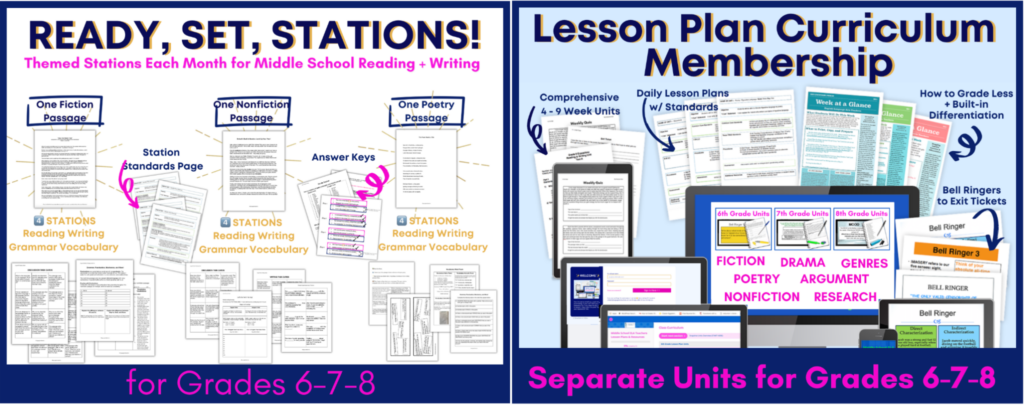
👉 Grab a year’s worth of stations here: Ready, Set, Stations™ and spend this month sipping your favorite resolution beverage of choice instead of overthinking lesson plans (‘cuz hi, I’ve already done that for you, too).