You know that moment when you start class by saying, “Okay friends, today we’re writing…”
…and a solid chunk of your class reacts like you just announced your school is moving to a 7-day school week?
Yeah…Writing in middle school is a whole thing.
For struggling writers, writing isn’t just “hard.”
It’s:
- overwhelming
- embarrassing
- mentally exhausting
- full of fear
- and weirdly personal even when it’s not personal
So they stall.
They sharpen the same pencil for 9 minutes.
They ask to go to the bathroom.
They “can’t find” their notebook.
They write three words and then stare at them like those words personally betrayed them.
And the most common phrase you hear is:
“I don’t know what to write” tied for first place with “I don’t get this” which is code for:
- I’m not sure what you want.
- I don’t know how to start.
- I’m scared I’ll do it wrong.
- I don’t know how to organize my thoughts.
- I can’t spell anything.
- I’m behind and I don’t want you to notice.
So here are 10 scaffolds that work: The kind that help struggling writers START, FINISH, and (miracle of miracles) actually feel proud of what they wrote.
Pick one, go in any order, and switch it up rather than feeling like you have to do all of them.
First: What “Scaffolding” Actually Means (in real teacher language)
Scaffolding isn’t “making it easier.”
It’s making it doable.
Scaffolds are the temporary supports that help students do the thinking until they can do it on their own.
So a good scaffold should:
✅ reduce overwhelm
✅ give structure
✅ build confidence
✅ create momentum
✅ eventually fade out
A bad scaffold:
❌ does the thinking for them
❌ makes them dependent
❌ becomes a crutch forever
We’re aiming for the good kind. The “training wheels” kind.
Scaffold #1: The “Write the Worst First Draft” Permission Slip
This is the #1 scaffold struggling writers need, and it costs you nothing.
A lot of kids don’t write because they think the first draft has to be perfect.
So they write… nothing.
What to say (script it + steal it):
“Your first draft is allowed to be trash.
That’s literally the point.
We can revise trash. We can’t revise a blank page.”
Say it with love. Say it daily. And model it for them by writing your own “trash” so they can see misspelled words, incomplete thoughts, and messy paragraphs (or no paragraphs at all to start)
Quick routine:
- Set a timer for 4 minutes
- Their job is to write anything
- No erasing, no restarting, no “I’m stuck”
Once you start, it gets easier.
➡️ Related[Building Confidence and Endurance in Middle School Writers]
Scaffold #2: The “Tiny Outline” (Because Big Outlines = Panic)
Struggling writers hear “outline” and immediately think:
“I’m about to do MORE writing before I even write.”
So we do what I call a tiny outline.
The 3-box outline (my ride-or-die)
Before students write, they fill in:
Box 1: My point is…
Box 2: My evidence/detail is…
Box 3: My explanation is…
That’s it. That’s the outline. And they don’t even have to use complete sentences at first. Doodles, words, phrases, all are welcome. It’s like a brain dump, and it gets the ball rolling.
Example (fiction response):
Point: Greg learns that treasures aren’t money.
Evidence: Lemon Brown keeps a harmonica and newspaper clippings.
Explanation: Those items show how pride and memories matter more than cash.
Now the paragraph basically writes itself.
Example (nonfiction response):
Point: The author believes failure helps growth.
Evidence: They explain that mistakes teach resilience.
Explanation: This shows struggle is part of success, not a sign to quit.
This scaffold is especially helpful if you’re teaching:
- constructed responses
- paragraph writing
- evidence-based writing
- theme responses
- short-answer test questions
➡️ Related: [Easy Ways to Teach Students How to Use Embedded Quotes for Text Evidence]
Scaffold #3: Sentence Starters That Don’t Sound Like Baby Talk
Let’s be real.
A lot of sentence starters sound like they were written for second graders.
And middle schoolers will absolutely reject anything that feels “babyish.”
So we use grown-up sentence frames that sound normal.
Better sentence starters for middle school:
To introduce a point:
- One important idea here is…
- The author shows…
- This scene reveals…
- A key message is…
To add evidence:
- For example,…
- In the text,…
- The author explains…
- One detail that stands out is…
To explain:
- This matters because…
- This suggests that…
- This reveals…
- As a result,…
To connect to theme:
- This connects to the idea that…
- This supports the theme of…
- This moment shows…
A simple rule:
Give them 4 options, not 14.
Too many choices = overwhelm = shutdown.
Scaffold #4: The “Because Ladder” for Elaboration (aka: Stop Writing One-Sentence Paragraphs)
Struggling writers don’t elaborate because they don’t know how. Give them a structure that forces depth.
The “Because Ladder”
After their evidence, they must write:
- This matters because…
- This shows…
- This connects to…
Example:
Evidence: Lemon Brown calls it his treasure.
- This matters because he’s not talking about money.
- This shows the treasure is personal and meaningful.
- This connects to the theme that memories can be more valuable than possessions.
Boom.
That’s a full paragraph. I mean, ok, it’s not 100% fully developed and there’s no embedded text evidence or transitions to the next paragraph, but it’s a start!
…And the student didn’t have to “magically think deeper.”
They followed a ladder.
Scaffold #5: “Write One Chunk at a Time” (Chunking = sanity)
Some kids freeze because they think they have to write the whole thing perfectly in one sitting.
Nope.
We chunk it.
Chunked drafting plan (perfect for 45–60 minute periods)
Chunk 1 (5 min): write the claim
Chunk 2 (5 min): add evidence
Chunk 3 (7 min): explain the evidence
Chunk 4 (5 min): closing sentence
Chunk 5 (3 min): quick reread + fix 2 things
Each chunk is small enough to complete, and each chunk creates momentum.
Teacher hack:
Put the chunk timers on the board because kids work better when the finish line is visible.
Scaffold #6: The “Example Bank” (use when they’re struggling to think of examples on the spot)
This is one of the sneakiest reasons kids don’t write:
They don’t have examples ready.
So when you ask:
“Explain how the character changes…”
Their brain goes:
🧠 Error 404: evidence not found.
Fix: Create an Example Bank
Before writing, students make a quick list based on the text:
Example Bank:
- 3 important actions
- 2 important quotes
- 1 important decision
Even if they don’t use all of them, it reduces panic.
Works great for:
- novels
- short stories
- memoir excerpts
- nonfiction passages
- theme and character analysis
Scaffold #7: “Choose Your Response” (Choice reduces resistance)
Sometimes struggling writers don’t write because they hate the prompt.
Or they don’t understand it.
Or they feel trapped.
So give them a choice of how to respond.
Choice menu:
Pick ONE:
- Write a paragraph response
- Write 6 sentences (still a paragraph, but it feels smaller)
- Write a claim + 2 evidence explanations
- Write a “Somebody Wanted But So Then” + 3-sentence analysis
Choices don’t lower standards, they lower the barrier to entry.
Scaffold #8: The “Micro-Conference” (because you can’t conference with everyone)
You can’t meet with every kid every day, and you aren’t an octopus. 🐙
So use micro-conferences.
Micro-conference rules:
- 60 seconds max
- You only look at ONE thing
- You leave them with ONE next step
Example micro-conference prompts:
- “Read me your claim.”
- “Show me your evidence.”
- “Point to where you explained your evidence.”
- “What are you trying to prove?”
Then you say something like:
“Okay, your next step is to add one ‘This matters because…’ sentence.”
That’s it. Move on.
Teacher shortcut:
Conference with:
- 5 kids per day
That’s 25 per week.
You’ll reach everyone without overextending yourself.
Scaffold #9: The “Revise One Thing” Rule (because revision feels impossible)
Struggling writers hear “revise” and think:
“I have to rewrite everything even though I already wrote all this stuff.”
Nope.
We revise ONE thing.
Revision menus (pick ONE… maybe ONE per paragraph, or any 3 for the whole essay, whatever makes sense for the assignment):
- Add 2 stronger verbs
- Add 1 sentence of explanation
- Combine 2 short sentences
- Replace 3 boring words
- Add 1 transition
- Add 1 piece of evidence
This makes revision doable and teaches the habit without overwhelm.
Scaffold #10: The “Done List” (not a checklist… a DONE list)
Some students don’t finish because they don’t know what “finished” looks like.
So you show them.
Done = this:
✅ claim sentence
✅ evidence sentence
✅ explanation sentence
✅ one “so what” sentence
✅ closing sentence
They can literally check it off as they write.
That’s motivating, and it keeps them from asking:
“Am I done now?” every three minutes.
How to Fade Scaffolds (so students don’t depend on them forever)
Okay, this part matters because scaffolds aren’t meant to be permanent.
Here’s how you fade them out over time:
Week 1–2: Full support
- sentence starters provided
- tiny outline required
- because ladder required
Week 3–4: Partial support
- choose 2 sentence starters
- outline optional
- “because ladder” encouraged
Week 5+: Independence
- no starters on paper
- students generate their own
- you only support when needed
The Real Secret: Struggling Writers Need Wins
Not “more pressure.”
Wins!
They need to feel like:
- I can start
- I can finish
- I can improve
- I’m not dumb
- Writing isn’t just for the smart kids
The scaffolds above create those wins quickly, which means students write more. …And when students write more, they improve over time.
Want to Make This Even Easier? Put It Into Stations 😄
You KNOW I’m going to say it since I’m 100% all about stations in the middle school ELA classroom.
These scaffolds are perfect for quick little 10 minute writing stations (write for 6 minutes, share with group members/get feedback for 4 minutes…that’s where I get the 10 minutes from):
Writing Scaffold Stations
- Station 1: Tiny outline (3-box)
- Station 2: Sentence starters + transitions
- Station 3: Evidence + “This matters because…”
- Station 4: Revision menu (revise one thing)
Your “Tomorrow Plan”
If you want to try this tomorrow, do this:
- Give them the 3-box tiny outline
- Give them 4 sentence starters
- Require 2 because sentences
- Set a timer for 10 minutes
- Collect nothing. Spot check.
That’s it: Start small and build the habit.
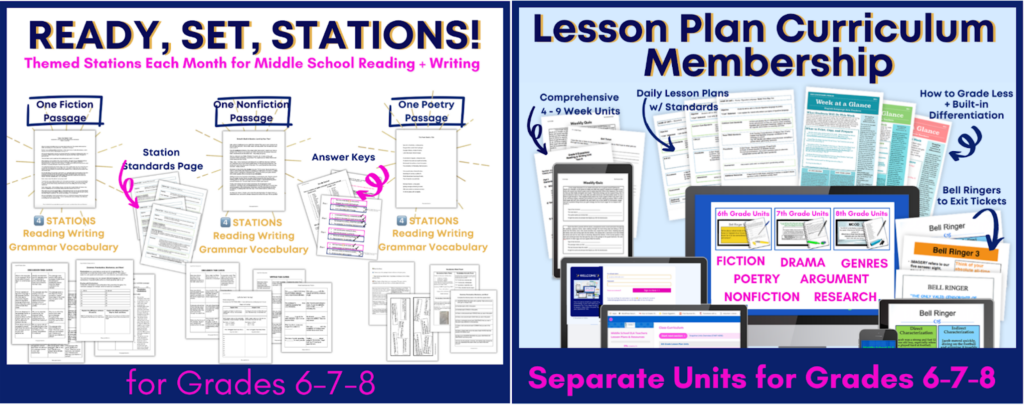
👉 Instead of scrambling for random activities, let me help you. I’ve done the heavy lifting and over-thinking on all things lesson planning. My Ready, Set, Stations™ collection has a fresh, monthly-themed set of stations ready to print and go.
👉 Grab your copy here:Ready, Set, Stations™ and make each month one that you spend more time savoring and less time scrounging for lesson plans.