Let me guess.
Your Middle School ELA students are “using evidence”… technically… in the same way I “meal prep” when I buy a rotisserie chicken and call it self-care.
They’re dropping a quote into their paragraph like it’s a mic drop… and then walking away.
No explanation. No connection. No thinking.
Just:
“In the text it says…”
…and then a random line from the story that kind of matches their point if you squint hard enough.
If you’ve ever written the comment “Explain how this proves your point” 47 times in one afternoon, welcome. You are among friends. 😄
The good news? Evidence-based writing is not some mystical unicorn skill only honors kids can do. It’s teachable. And you don’t need a 3-week unit to make it click.
You need mini-lessons that hit the exact moments students go off the rails.
So here are 5 quick mini-lessons you can teach in short bursts (think: 8–12 minutes each) that will finally help your middle schoolers move from:
📉 quote dumping → 📈 real evidence + real thinking
And yes, they work for short stories, novels, passages, and nonfiction.
Mini-Lesson #1: The “Evidence Isn’t the Answer” Reset
The problem:
Students treat evidence like the final answer.
They think the assignment is:
“Find a quote.”
Not:
“Prove your thinking.”
So their paragraph becomes a scavenger hunt, not an argument.
What to teach:
Evidence is not the answer. Evidence is proof.
Say this out loud:
“The quote is not your point. The quote is your receipt.”
(Yes, I fully support calling it a receipt. Kids get it instantly.)
Try this quick activity:
Write a claim on the board, like:
Claim: Lemon Brown’s treasure is valuable because it represents pride and identity.
Then give them 3 “evidence options” (real or made-up lines are fine):
A) “He had a battered harmonica.”
B) “It’s my treasure.”
C) “You mean you sure treasure that harmonica.”
Ask:
- Which one is best proof?
- Which one is weak proof?
- Which one is not proof at all?
Why this works:
It trains their brains to stop grabbing the first quote they see and start choosing evidence intentionally.
Teacher shortcut:
Do this as a bell ringer once a week. 5 minutes. Done.
➡️ Related: How to Teach Theme vs. Topic
Mini-Lesson #2: The “Quote Sandwich” That Doesn’t Taste Like Cardboard
The problem:
Kids either:
- drop a quote with zero setup
or
- introduce it like a robot: “This quote shows…”
We want something more natural and structured.
What to teach:
The Quote Sandwich (but upgraded for middle school brains).
Top bun (Introduce it): Who/when/what’s happening?
Meat (Evidence): the quote or paraphrase
Bottom bun (Explain it): what it proves + why it matters
Give them a sentence frame that actually helps:
Instead of “This quote shows…”
Try:
- At this moment, ____ realizes ____ when ____ says, “_____.”
- This matters because _____.
- This proves ____ because _____.
Example (fiction):
Claim: Charlie feels hopeful after the surgery.
Evidence + explanation:
At this moment, Charlie starts to believe his life is changing when he says, “I’m smart now.” This matters because it shows he connects intelligence with worth, and he’s finally feeling confident.
Example (nonfiction):
Claim: The author believes failure is necessary for growth.
The author explains that “mistakes are proof you’re trying.” This matters because it reframes failure as progress, not weakness.
Why this works:
Students stop writing “quote + period.”
They start writing quote + meaning.
➡️ Related: Teaching Embedded Quotes for Middle School Students
Mini-Lesson #3: The “So What?” Strategy (AKA: Explain Like You’re Not in Trouble)
The problem:
Students think they explained… but they just repeated the quote.
Example:
“He was nervous.”
“This shows he was nervous.”
Groundbreaking. Pulitzer-worthy. 😅
What to teach:
After evidence, they must answer:
SO WHAT?
And not in a vague way. In a “connect to the claim” way.
A super simple rule:
Evidence tells WHAT happened. Explanation tells WHY it matters.
Try this:
Give them a list of “So What” stems:
- This matters because…
- This reveals that…
- This suggests that…
- This proves that…
- This is important because…
- As a result…
- This connects to the theme of…
Then require:
✅ One stem per paragraph
✅ No repeating the quote
Example (The Treasure of Lemon Brown):
Evidence: “It’s my treasure.”
So what:
This matters because Lemon Brown isn’t talking about money—he’s talking about pride and memories, which shows that treasure can be personal.
Why this works:
It forces thinking. Not summarizing.
Teacher hack:
Make it a checklist:
- Evidence? ✅
- So what sentence? ✅
No “so what” = not done.
Mini-Lesson #4: The “Evidence Ladder” (Stop Using Baby Quotes)
The problem:
Students use tiny “baby quotes” that don’t actually prove anything.
Like quoting one word:
“He was ‘sad.’”
Okay… and? That proves he knows the word sad.
What to teach:
Evidence has levels. Like a ladder.
Level 1: One-word proof (weak)
Level 2: Phrase proof (better)
Level 3: Full sentence proof (strong)
Level 4: Moment/scene proof (strongest—summarized or paraphrased)
The rule:
The bigger the claim, the stronger the evidence needs to be.
Try this activity:
Give them a claim and ask them to find:
- one Level 2 quote
- one Level 3 quote
- one Level 4 paraphrase
Then ask:
Which one proves the claim BEST?
This is where kids realize:
“Ohhh… the scene is evidence too.”
YES. IT IS. 🎉
Why this works:
It helps struggling writers who can’t find perfect quotes but can describe a moment.
That’s still evidence-based writing.
➡️ Related: Reading Response Ideas That Aren’t Just Worksheets
Mini-Lesson #5: The “Because…Because…Because” Explanation Builder
The problem:
Students don’t know how to elaborate without rambling.
They either write:
- one short sentence
or - a chaotic paragraph that sounds like a TikTok comment section
What to teach:
A structured explanation chain.
Here’s how it looks:
Claim + Evidence + Explanation
Then add:
Because… because… because…
Three layers of reasoning.
Example:
Claim: Greg values his father’s advice.
Evidence: Greg remembers his dad saying, “If you know what you’re worth, nobody can tell you different.”
Explanation chain:
This proves Greg values his father’s advice because he remembers it in a stressful moment. It’s important because it shows how his dad’s words shaped how he thinks about confidence. Ultimately, Greg realizes that a treasure isn’t an object, it’s the lessons you carry.
Why this works:
It gives students a “ladder” for elaboration without requiring them to magically become eloquent overnight.
Teacher shortcut:
Require 2 “because” sentences minimum for body paragraphs.
Put It All Together: The “Evidence Paragraph Recipe” (teacher-friendly + repeatable)
If you want your students writing stronger paragraphs by next week, use this recipe:
Evidence Paragraph Checklist
- Claim sentence (your point)
- Evidence (quote OR paraphrase)
- Introduce the evidence (who/when/where)
- So what sentence (why it matters)
- Because-because explanation (2 layers)
And you can teach this throughout the year without reinventing the wheel.
The Best Part–This Works in Stations
If you’re a stations teacher (hi, soulmate), you can turn these into 5 rotating stations:
Evidence-Based Writing Stations:
- Station 1: Choose the best evidence (Mini-Lesson #1)
- Station 2: Build the quote sandwich (Mini-Lesson #2)
- Station 3: Add the “So What?” (Mini-Lesson #3)
- Station 4: Level up weak evidence (Mini-Lesson #4)
- Station 5: Expand with because-because-because (Mini-Lesson #5)
Each station can be as little as 8 minutes in length.
➡️ Related: How to Run ELA Stations the Easy, Realistic Way
Quick Teacher Pep Talk
If evidence-based writing feels like it “should” be easier… you’re not wrong.
But you’re also not crazy.
Middle schoolers are still learning how to:
- think clearly
- organize ideas
- explain reasoning
- AND write in complete sentences
…all at the same time.
That’s a lot.
So if you teach these mini-lessons one at a time, repeatedly, in small chunks, they WILL improve.
…And you’ll stop writing “explain” in the margins like it’s a whole separate full-time job.
Want this done-for-you?
If you want plug-and-play versions of these mini-lessons (with student pages, examples, and answer keys), that’s exactly the kind of thing I build inside my lesson plan resources + station sets.
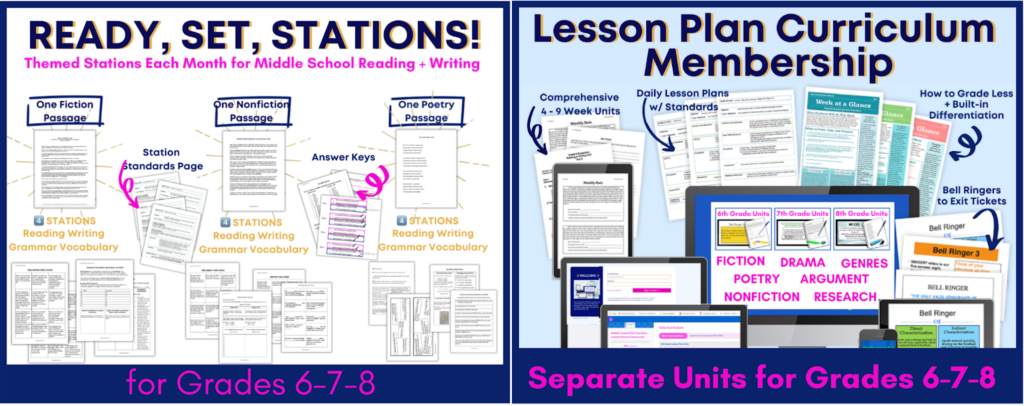
Take a peek at my ready-made ELA Lesson Plan Units or Ready, Set, Stations™, where you’ll be able to teach with confidence and still go home earlier each day.